


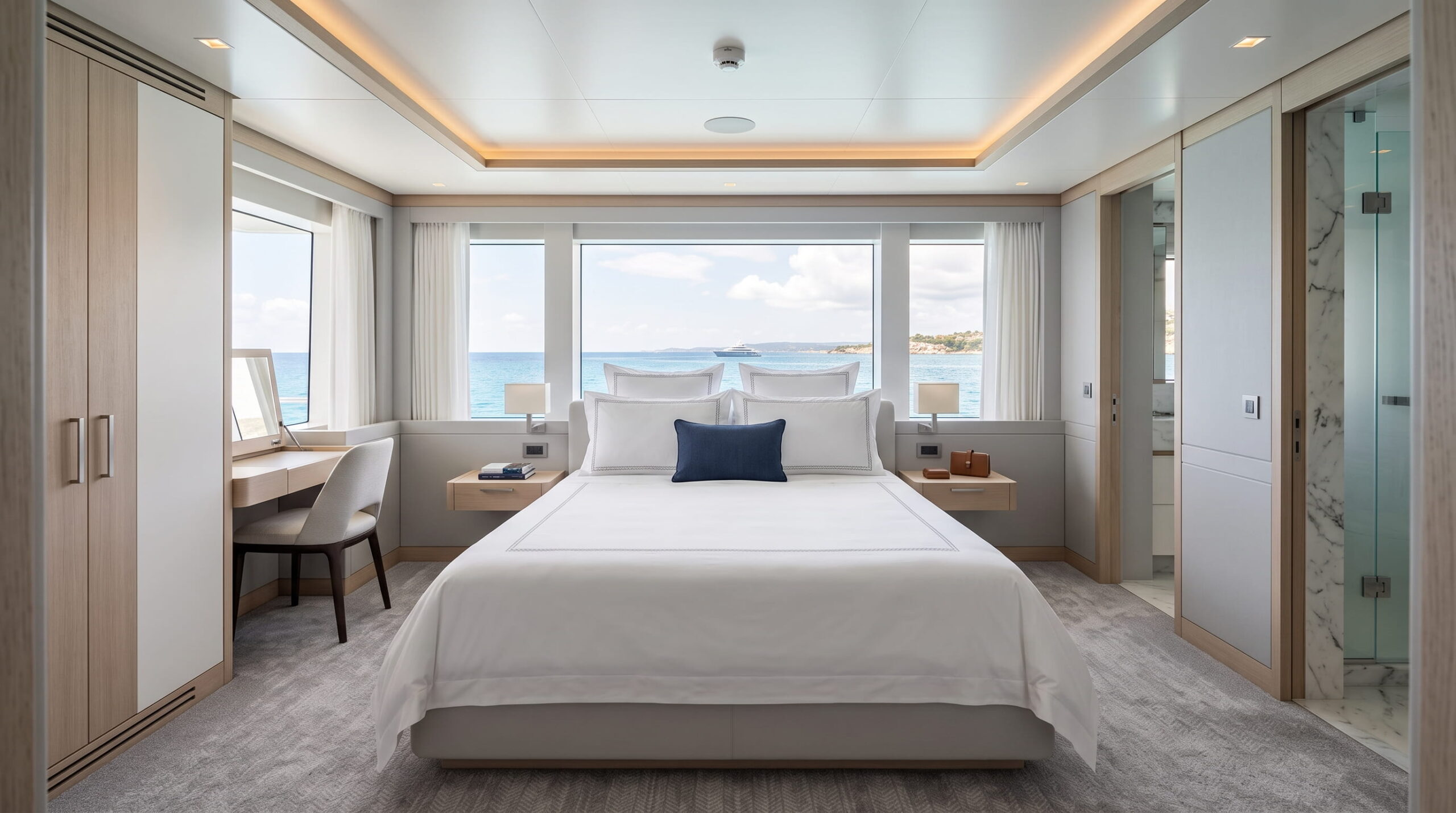
Percale is the better choice for warm, humid cabins and fast laundry turnarounds, because the flat weave breathes and dries quickly. Sateen suits owners who want a smoother, heavier sheet with more drape and less wrinkling. Many vessels carry both, one weave per cabin type.
Neither weave is better in the abstract. What decides it aboard is air movement, laundry capacity, and who sleeps in the cabin.
What is the difference between sateen and percale?
Both are weaves, not fibers. The same long-staple Aegean cotton can be woven either way, and the result feels completely different.
Percale uses a plain weave, one thread over and one thread under, repeated across the fabric. That structure leaves small gaps for air to pass through and gives percale its matte finish and crisp hand.
Sateen uses a float weave, typically four threads passing over one before tucking under. More thread surface sits on the face of the fabric, which is why sateen looks softly lustrous and feels smooth against the skin.
| Percale | Sateen | |
|---|---|---|
| Weave | One over, one under | Four over, one under |
| Feel | Crisp, cool, matte | Smooth, soft, gently lustrous |
| Typical thread count | 200 to 400 | 300 to 600 |
| Breathability | High | Moderate |
| Drying time | Faster | Slower |
| Wrinkling | Wrinkles more | Wrinkles less |
| Best aboard for | Warm cabins, charter turnover, crew | Master cabins, cooler seasons, owners who prefer drape |
Which weave handles humidity better aboard?
A yacht cabin is a small, enclosed volume with limited air exchange. When the boat sits at anchor with the air conditioning off, humidity climbs fast and stays there.
Percale is the safer weave in that environment. Air moves through the plain weave, moisture leaves the fabric faster, and the sheet does not hold warmth against the body. Guests who describe sheets as feeling damp are usually describing a dense weave in a humid cabin, not a laundry problem.
Sateen holds a little more warmth by design. In a well-conditioned master cabin, that is exactly what some owners want, particularly in winter or in northern cruising grounds. In an unconditioned forward cabin in August, it is the wrong tool.
If your vessel runs charters in the Caribbean or spends summers in the Mediterranean, start with percale and add sateen where the cabin conditions justify it. The same logic applies to towels, where drying time matters even more.
How does each weave hold up in yacht laundry?
Laundry aboard is the real durability test. Machines are small, cycles are short, and during charter season the same sets go around every few days.
Percale tolerates that rhythm well. The interlocked structure resists abrasion, and the fabric softens with washing rather than breaking down. The trade-off is wrinkling: percale comes out of a dryer with creases, and a crisp presentation usually means pressing.
Sateen wrinkles less and often looks made without pressing, which saves crew time before a guest arrival. In exchange, the exposed threads on the face of the fabric are more prone to snagging and pilling, especially with hot washes, harsh detergents, and heavy dryer cycles.
One point matters more than the weave here. Fiber length drives longevity. A sheet woven from long-staple cotton at a moderate thread count will outlast a dense sheet made from short fibers, in either weave.
Does thread count matter more than the weave?
No, and comparing thread counts across weaves is misleading. Percale works best between 200 and 400 threads per square inch. Push higher and the weave closes up, which costs you the breathability that made percale worth choosing. Sateen naturally runs between 300 and 600 because the float structure accommodates more threads before the fabric becomes stiff.
A 300 thread count percale in long-staple cotton is a better sheet than a 600 thread count sateen in short-staple cotton. The number on the label tells you how many threads are present, not how good they are.
This is why MIRA Yacht Interiors specifies fiber first. Every sheet is woven from long-staple Aegean cotton, sourced direct from the mills on Turkey’s Aegean coast, then cut to the berths aboard your vessel. You can see the full range in our Bed Linens collection.
Which cabins suit which weave?
A simple way to plan a vessel:
- Master cabin: owner preference wins. Sateen if they like weight and drape, percale if they run warm.
- VIP and guest cabins: percale is the safer default, since you cannot predict how each guest sleeps.
- Forward cabins: percale, because these cabins are typically warmer and less ventilated.
- Crew cabins: percale, for fast drying and hard wear.
- Seasonal sets: sateen for winter charters and northern itineraries, percale for summer.
Fleet operators often standardize on percale across sister vessels for one practical reason: sets become interchangeable, and a damaged sheet can be replaced from stock rather than reordered by cabin.
Can you use both weaves aboard?
Yes, and most well-specified vessels do. The usual approach is percale throughout, with a sateen set in the master and a second sateen set held for winter.
Mixing weaves works as long as the color and finish stay consistent, so cabins still read as one interior. That is a specification decision, not a purchase decision, and it is worth settling before the first order rather than after. Our How It Works page walks through how we record measurements and specifications per cabin, and How Does Custom Yacht Bedding Work? covers the process end to end.
Whichever weave you choose, every piece is cut to your berths, including tapered and curved mattresses, at no extra charge for custom sizes. Quotes usually reach you within 48 hours, and production takes about 3 to 4 weeks.
Frequently asked questions
Which is cooler on a yacht, sateen or percale?
Percale. Its plain weave lets air pass through, so it sleeps cooler and dries faster in warm, humid cabins.
Which weave wrinkles less?
Sateen. It usually looks made without pressing, which saves crew time before a guest arrival.
Does sateen pill faster than percale?
It can, because more thread surface sits on the face of the fabric. Long-staple cotton and gentle wash cycles reduce the risk.
What thread count should we order?
Percale performs best between 200 and 400, sateen between 300 and 600. Fiber length matters more than the number itself.
Can we use percale in guest cabins and sateen in the master?
Yes. MIRA Yacht Interiors specifies weave per cabin and keeps color and finish consistent so the interior still reads as one set.
Tell us your cabin layout and how the vessel is used, and we will recommend a weave per cabin along with an itemized quote. Request a quote.